

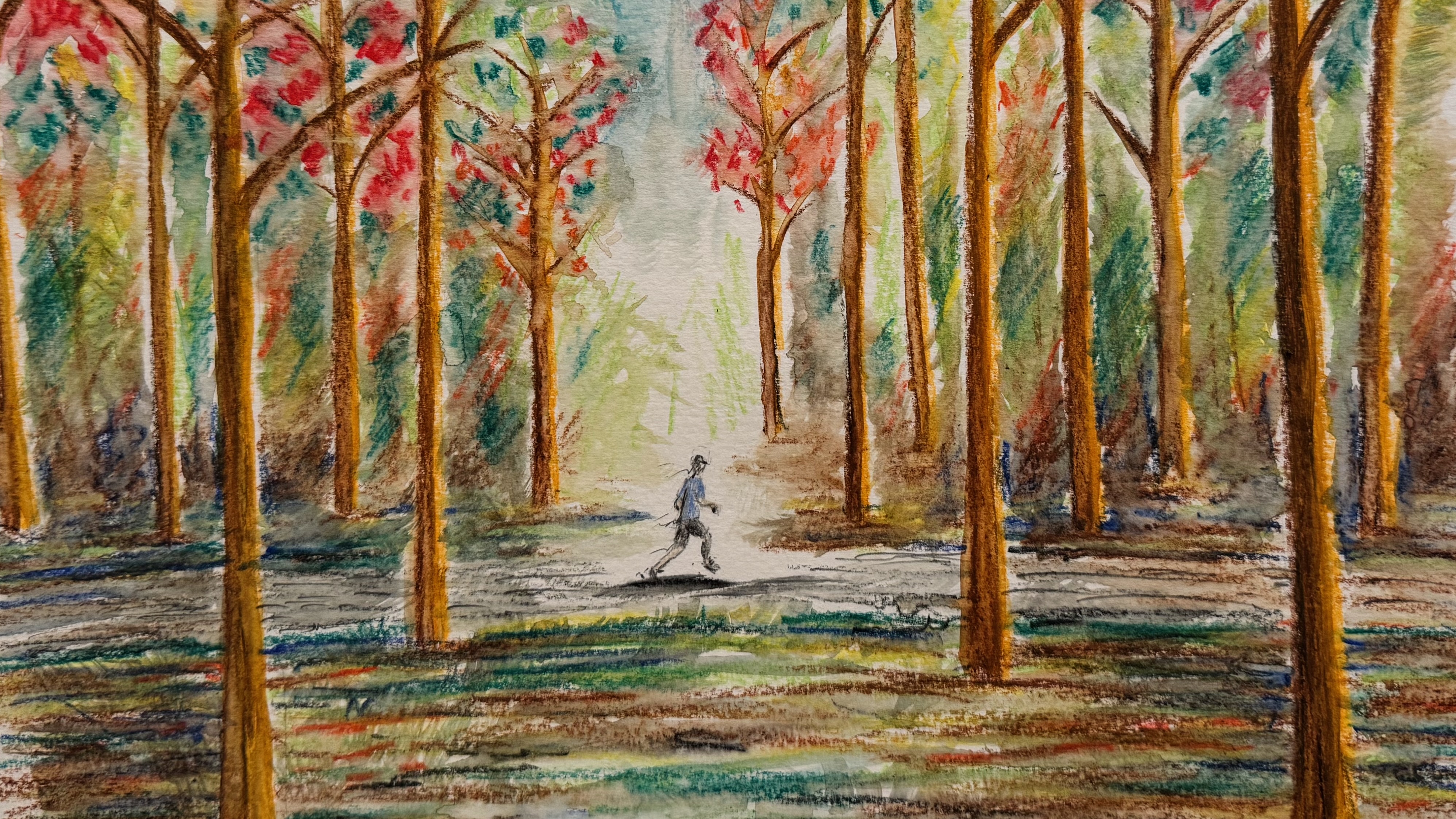
“How do you flip the internal switch that changes us all back into the Natural Born Runners we once were? […] running was mankind’s first fine art, our original act of inspired creation. Way before we were scratching pictures on caves or beating rhythms on hollow trees, we were perfecting the art of combining our breath and mind and muscles into fluid self-propulsion over wild terrain. And when our ancestors finally did make their first cave paintings, what were the first designs? A downward slash, lightning bolts through the bottom and middle-behold, the Running Man.”
(Christopher McDougall, Born to Run)
The compelling premise of Christopher McDougall’s book Born to Run is that all humans are natural-born runners. It’s a fun read for anyone who is currently a runner or wants to do more of it (and if so, you should do it; it might be just what you need!).
The book weaves a tale of McDougall searching for a lost people called the Rarámuri (or Tarahumara) and then embarking on an epic ultra-marathon with them. It provides insights about his own battles with running injuries and debunks widely held perceptions that the human body is not suited for running long distances with extensive first-hand accounts and many studies done over the years.
For example, I always thought I needed to replace my running shoes once they hit 400 miles (or so) of running. I guess it’s no surprise who that “rule” really benefits, but I hadn’t really thought hard about it until now.
“When E. C. Frederick, then the director of Nike Sports Research Lab, arrived at the 1986 meeting of the American Society of Biomechanics, he was packing a bombshell. “When subjects were tested with soft versus hard shoes,” he said, “no difference in impact force was found.” No difference! “And curiously,” he added, “the second, propulsive peak in the vertical ground reaction force was actually higher with soft shoes.”
The puzzling conclusion: the more cushioned the shoe, the less protection it provides.
Researchers at the University of Oregon’s Biomechanics/Sports Medicine Laboratory were verifying the same finding. As running shoes got worn down and their cushioning hardened, the Oregon researchers revealed in a 1988 study for the Journal of Orthopaedic & Sports Physical Therapy, runners’ feet stabilized and became less wobbly. It would take about ten years before scientists came up with an explanation for why the old shoes that sports companies were telling you to throw away were better than the new ones they were urging you to buy. At McGill University in Montreal, Steven Robbins, M.D., and Edward Waked, Ph.D., performed a series of tests on gymnasts.
They found that the thicker the landing mat, the harder the gymnasts stuck their landings. Instinctively, the gymnasts were searching for stability. When they sensed a soft surface underfoot, they slapped down hard to ensure balance.
Runners do the same thing, Robbins and Waked found: just the way your arms automatically fly up when you slip on ice, your legs and feet instinctively come down hard when they sense something squishy underfoot. When you run in cushioned shoes, your feet are pushing through the soles in search of a hard, stable platform.”
[…] consider these words by Dr. Daniel Lieberman, a professor of biological anthropology at Harvard University:
“A lot of foot and knee injuries that are currently plaguing us are actually caused by people running with shoes that actually make our feet weak, cause us to over-pronate, give us knee problems. Until 1972, when the modern athletic shoe was invented by Nike, people ran in very thin-soled shoes, had strong feet, and had much lower incidence of knee injuries.””
This is just one example of a whole host of interesting insights and stories within a book that contains a raft of unforgettable characters. I would consider it essential reading for anyone remotely interested in running or real-life outdoor adventure stories.
“Every morning in Africa, a gazelle wakes up. It knows it must outrun the fastest lion or it will be killed.
Every morning in Africa, a lion wakes up. It knows it must run faster than the slowest gazelle, or it will starve.
It doesn’t matter whether you’re a lion or a gazelle when the sun comes up, you’d better be running.”


Leave a Reply to NickCancel reply